
Mason County Court Records After a Jail Arrest
The path from a Mason County jail arrest to a court record runs through more than one public system. Mason County Jail publishes custody reports, and those reports may show a booking number, book date, statute, offense wording, court abbreviation, offense code, and class. Those rows are useful, but they are not the same thing as the formal court case. A court record begins to matter when the case is filed, scheduled, amended, dismissed, resolved by plea, or taken to trial.
The Mason County offense list uses court labels such as DIST, MUNI, SUPR, DOC, and OTHR. DIST points toward District Court matters. MUNI may involve Shelton Municipal Court. SUPR points toward Superior Court, especially felony criminal cases and appeals from lower courts. DOC signals a Department of Corrections hold or authority rather than a new county court case. For custody and booking details, use the Mason County jail inmate records page; for booking-photo limits, use the Mason County jail mugshots page.
The prosecutor is the bridge between an arrest report and a filed charge. The Mason County Prosecutor page names Michael K. Dorcy as Prosecutor and describes criminal prosecution as advice to law enforcement, charging decisions, plea negotiations, pretrial hearings, trials, sentencing hearings, and appeals. That local role explains why a jail offense row can change once the formal court record opens.
How to Find Mason County Court Records After an Arrest
Start with the jail offense report only to orient the search. The official Mason County report can show the court abbreviation and offense text, but formal case records are searched through Washington court systems or requested from the correct Mason County court office. The Washington Courts Case Search portal supports court-level choices, person or business name search, and case-number search.
- Open the Mason County Current Inmate Offense List and note the name, booking number, book date, statute, offense, and court abbreviation.
- Use Washington Courts Case Search, choosing Superior Courts for SUPR matters or District and Municipal Courts for DIST and MUNI matters.
- Search by defendant last name and first name, or by case number if court paperwork already lists one.
- Compare the jail offense row with the formal court charge, then check hearings, status, disposition, and warrant entries.
| Search Field | How It Helps | Mason County Use |
|---|---|---|
| Court Level | Separates District/Municipal, Superior, and appellate courts. | Use SUPR, DIST, or MUNI from the jail report to pick the likely path. |
| Case Number | Finds a known case directly. | Best when paperwork, a notice, or a clerk gives the exact number. |
| Person Name | Finds cases by defendant name. | Use full name from the jail PDF and verify with other identifiers. |
| Date of Birth | Can help separate people with similar names where offered. | Use only when available from lawful records, since the jail PDF does not publish DOB. |
Case Search is a starting point, not the only record source. Mason County District Court publishes a separate records-request process, and Superior Court case documents are filed through the Clerk's Office. Court staff, not the jail roster, confirm whether a document copy is available, restricted, or subject to court rules.
District, Superior, and Shelton Municipal Court Routing
Mason County court records after an arrest depend on charge level and filing court. Mason County District Court handles misdemeanors, gross misdemeanors, infractions, small claims, civil, and miscellaneous matters. Mason County Superior Court handles felony criminal cases and appeals from District Court and Shelton Municipal Court. Shelton Municipal Court can appear through the MUNI abbreviation when the case is tied to municipal authority.
For District Court copies, the District Court records page says a clerk reviews requests, determines access and copy costs, and requires payment before copies are released. Electronic-to-paper copies are listed at $0.25 per page, paper copies at $0.50 per page, certified copies at $5.00 for the first page plus $1.00 for each added page, and court proceeding duplication at $20.00 per CD. Administrative records carry a $30.00 per hour research or preparation charge after the first hour, billed in 15-minute increments.
The official Mason County District Court records-request page publishes the copy-request process and fee schedule.
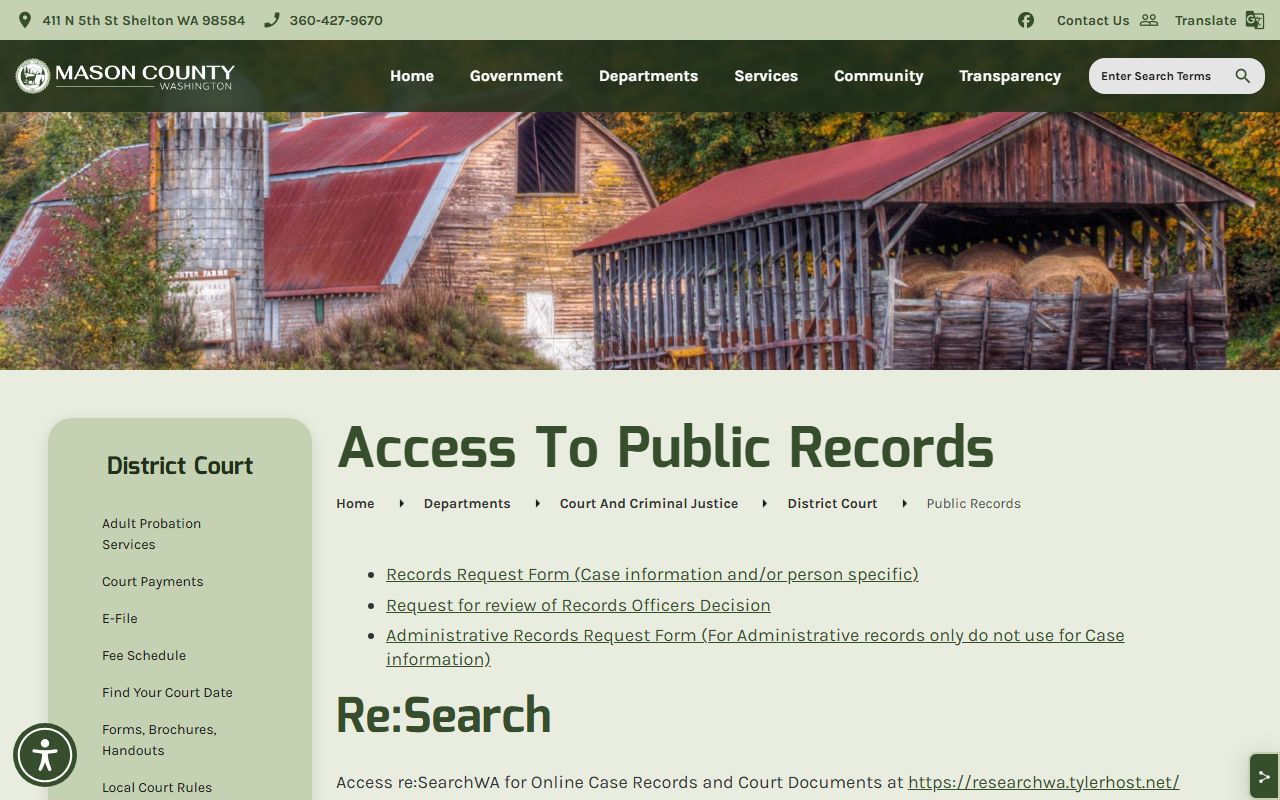
That separate court-copy process is why jail records and filed court documents should be requested through different Mason County channels.
Superior Court documents follow a different route. The county's Superior Court documents page says Superior Court cases and documents are filed through the Clerk's Office, so a felony court record after a jail arrest should not be sent to the Sheriff's records contact unless the requested record is a jail or law-enforcement record.
Note: A jail report can point to the likely court, but the filing court controls document access and current case status.
How Court Charges Get Filed After an Arrest
After a Mason County arrest, the booking record may list an offense before the final court charge is set. Prosecutor Michael K. Dorcy's office reviews reports, works with law enforcement during investigations, and decides whether charges should be filed. Adult felonies are prosecuted in Superior Court, adult misdemeanors in District Court, juvenile cases in Superior Court's juvenile division, and appeals in appellate courts.
| Document Type | Who Usually Files It | How It Fits the Court Record |
|---|---|---|
| Complaint | Prosecutor or officer-supported filing | Often starts a misdemeanor or gross-misdemeanor case after arrest review. |
| Information | Prosecutor | Common formal charging document for felony matters in Superior Court. |
| Indictment | Grand jury process | Less common, but still a formal charging path for serious allegations. |
The charging document is where the court record becomes more precise than the jail row. It may name different counts, amended wording, a different charge level, or fewer charges than the arrest report suggested. A person can be arrested and booked, yet later have a charge reduced, dismissed, or not filed.
Charge Status in Mason County Court Records
Charge status is the part of a court record that often answers the practical question a jail roster cannot answer. The Mason County offense PDF can show a listed offense, but it does not show every court event, every motion, or the final disposition. The court record is the better place to check whether a charge is pending, amended, reduced, dismissed, or resolved by plea or verdict.
| Status | What It Means | Why It Matters After Arrest |
|---|---|---|
| Pending | The filed charge has not reached final disposition. | Hearings, release terms, and warrants may still change. |
| Amended | The prosecutor changed the charge or count language. | The court record may no longer match the original jail offense wording. |
| Reduced | The charge level or offense was lowered. | A plea or filing decision may have changed the case exposure. |
| Dismissed | The court or prosecutor ended the charge without conviction. | The arrest record may still exist even when the court charge is dismissed. |
| Conviction | A guilty plea or finding resolved the charge. | Sentencing may lead to jail time, community custody, or DOC transfer. |
Bond, Release, and Holds After a Mason County Arrest
Mason County's public jail PDFs did not show bond amount or bond type in the inspected roster records. That is an important limit. For release questions, use the jail roster to identify whether the person is held on a new arrest, warrant arrest, failure to appear, court commitment, probation or parole violation, DOC hold, or other-agency hold, then confirm current release conditions with the jail or the court of record.
| Release Term | How It Works |
|---|---|
| Cash bail or bond | Money deposited as ordered by the court, subject to the court's rules and current case status. |
| Surety bond | A licensed bail bond agent may post bond if the court permits that type of release. |
| Personal recognizance | Release based on a promise to appear, often with nonfinancial conditions. |
| No-bond or agency hold | A court commitment, DOC hold, other-county warrant, or federal or immigration detainer may block release. |
Washington release decisions are made by a judge or court under criminal court rules and constitutional standards. The prosecutor may recommend terms, defense counsel may argue for release or lower bail, and the court decides. Do not treat court fine payment links as bond instructions unless a court has directed that exact process.
Warrants in Court Records After a Jail Arrest
No official Mason County Sheriff's active warrant search page was located in the research. The jail offense report can show that a person currently in Mason County Jail is held on warrant-related authority, including examples such as Failure to Appear and Warrant Arrest. That does not make the jail PDF a complete active-warrant index for people not in custody.
The Washington Courts warrant FAQ says AOC case search may help locate the court, but active warrant information can lag, so current warrant status should be confirmed with the court. For DOC secretary's warrants, the Washington DOC warrant search is a separate state tool searchable by name, DOC number, crime, or county.
Note: Do not assume a warrant is cleared because a web search looks quiet; the court of record has the current warrant answer.
Charges, Convictions, Sealed Records, and Expungement
Public court records after an arrest need careful reading because similar terms mean different things. A charge is an accusation in a filed case. A conviction is a formal outcome by plea or finding. A sealed record is hidden from ordinary public access under a court order or rule. Expungement or deletion is narrower and depends on the record type and Washington law.
| Comparison | First Term | Second Term |
|---|---|---|
| Charge vs. Conviction | A charge is an allegation filed in court. | A conviction is a guilty plea or finding. |
| Sealed vs. Expunged | Sealed records are restricted from public view but may still exist. | Expunged or deleted records are treated differently and require specific legal authority. |
Washington's Public Records Act supports access to identifiable agency records, but exemptions, court rules, juvenile protections, active investigations, privacy limits, and redactions can restrict release. For jail records, RCW 70.48.100 is also relevant because it addresses jail-register and jail-record information.
Records Requests for Mason County Court and Arrest Records
Use the right records channel for the record type. Court case copies go through District Court or the Superior Court Clerk, depending on the case. Jail booking records, jail records, and law-enforcement records go through Mason County public-records channels or the Sheriff's records contact. The county public-records page points to an online portal, agency contacts, District Court links, Superior Court administrative-record links, and printable request materials.
The Mason County public-records page and the linked online public-records portal are the broad county request path. RCW 42.56.520 requires an agency response within five business days by providing records, acknowledging the request and estimating time, asking for clarification, denying the request, or otherwise acting under the statute.
Important: Private record searches are not consumer reports and must not be used for employment, tenant screening, credit, insurance, or other FCRA-covered decisions.